Trial of Crushed Recycled Concrete (CRC) in Carpark Basecourse in METRONET Morley-Ellenbrook Line
Trial of Crushed Recycled Concrete (CRC) in Carpark Basecourse in METRONET Morley-Ellenbrook Line
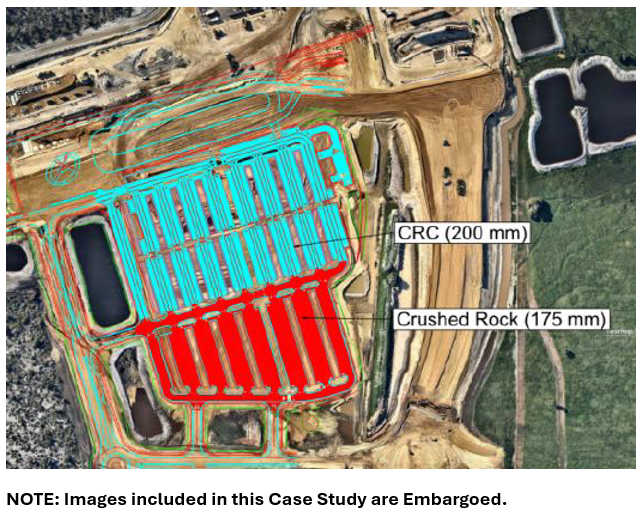
Typically, crushed recycled concrete (CRC) is considered a waste stream from construction and demolition waste. In order to facilitate a circular economy outcome and add value to this recycled waste stream through demand for the product, PTA has approved the use of CRC for basecourse aggregate within the Malaga Station upper carpark and Noranda Station car park as a trial. Specifications usually restrict the use of CRC in basecourse applications or under any location not covered by full depth asphalt or at least 230 mm high-modulus crushed rock basecourse, with specific exceptions on PTA assets. Noranda and Malaga upper car park were identified as areas where the implementation of CRC was compliant with PTA’s specification, noting that Malaga lower carpark was within 0.5 m of the maximum groundwater level and therefore deemed inappropriate for CRC implementation.
Challenges and outcomes
Challenges:
- CRC is typically considered a higher-risk material for basecourse applications, and its use is restricted by specifications.
- The trial required compliance with PTA specifications and careful selection of suitable locations.
- The lower carpark at Malaga was excluded due to proximity to groundwater.
Outcomes:
- It is planned that a total of 21,350 tonnes of CRC will be installed as basecourse at Noranda station car park and upper car park at Malaga Station. To date, 10,461 tonnes have been placed at Malaga Station car park.
- Estimated ~0.7 tonnes of CO₂e saved by replacing 21,350 tonnes of virgin crushed rock typically used as basecourse through substitution with CRC.
- Circular economy opportunity implemented to generate value for a waste stream.
Next steps
- Trial implementation, if successful, will facilitate the wider uptake of this recycled/reused material in applications that have typically been considered higher risk.