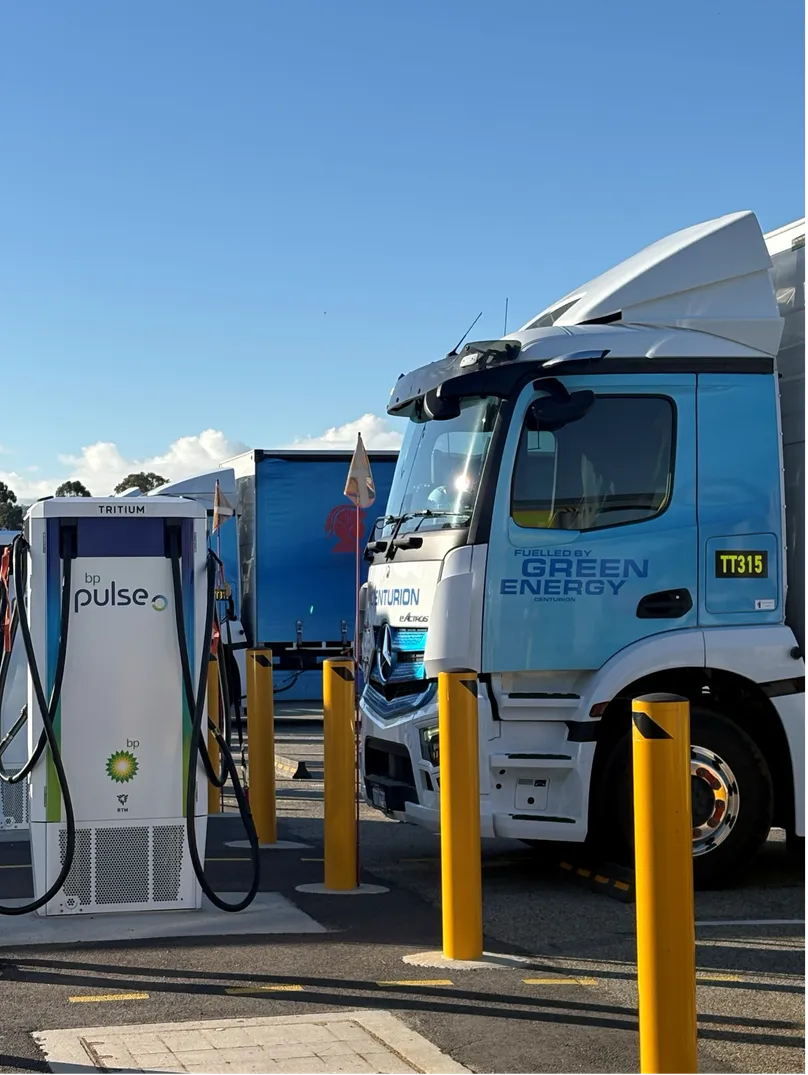
Heavy vehicles
Heavy vehicles are essential to Western Australia’s freight network but are a major source of emissions. While they represent less than 5% of the State’s vehicle fleet, they generate almost 30% of road transport greenhouse gas emissions.
Why Decarbonising Heavy Vehicles Matters?
Heavy vehicles are essential to economic activity but are typically reliant on diesel fuel.Transitioning to lower-emission technologies can help:
- Reduce greenhouse gas emissions from freight transport.
- Improve urban air quality by reducing particulate emissions.
- Lower dependence on imported diesel fuel and improve fuel security.
- Support Western Australia's transition towards net zero emissions.
- Create opportunities for innovation in freight, energy and charging infrastructure.
Battery-Electric Trucks
Battery-electric trucks are the most mature zero-emission heavy vehicle technology and are expected to play a key role in reducing reliance on diesel.
Australia’s battery-electric truck market has grown rapidly, from three brands in 2023 to fifteen brands offering around thirty models by late 2025. Around 60 battery-electric trucks were operating in Western Australia by the end of 2025.
Suitable Applications
Analysis undertaken for Western Australia has identified several freight tasks where battery-electric trucks are already technically viable today:
- Metropolitan freight and delivery operations.
- Regional short- and medium-haul freight.
- Return-to-base fleet operations.
- Waste collection and municipal services.
- Government and commercial fleet vehicles with predictable daily routes.
These applications are well suited to depot-based charging and generally operate within thecurrent range capabilities of battery-electric vehicles.
Challenges to Adoption
Despite growing momentum, several barriers continue to slow adoption of battery-electric trucksin Western Australia.
- Higher upfront costs: Electric trucks remain more expensive to purchase than equivalentdiesel vehicles.
- Charging infrastructure: Suitable heavy vehicle charging infrastructure remains limited.
- Fleet characteristics: More than 95% of WA truck operators have fewer than ten trucks,creating financial barriers to adoption.
- Market maturity: Charging, workforce skills and supporting services are still developing.
Charging Infrastructure
Depot charging is expected to meet most electric truck energy demand. Public and shared charging will support longer-distance operations, fleets without dedicated facilities and top-up charging during the day.
By 2035, WA analysis indicates electric truck energy demand could be supplied through:
- 65% depot-based charging.
- 13% shared or public charging.
- 22% off-site and mid-shift charging.
Heavy Vehicle Decarbonisation Strategy
The Department of Transport and Major Infrastructure (DTMI) is developing a Heavy VehicleDecarbonisation Strategy as a key action in the WA Sectoral Emission Reduction Strategy to support Western Australia’s transition from diesel-powered trucks to lower-emission technologies, with a focus on battery-electric trucks.
The Strategy and supporting roadmap will identify actions to address key barriers, including vehicle costs, charging infrastructure, workforce capability and market readiness.
DTMI is also developing education and awareness videos to showcase battery-electric truck technologies and suitable freight applications, helping fleet operators make informed decisions about electrification.